
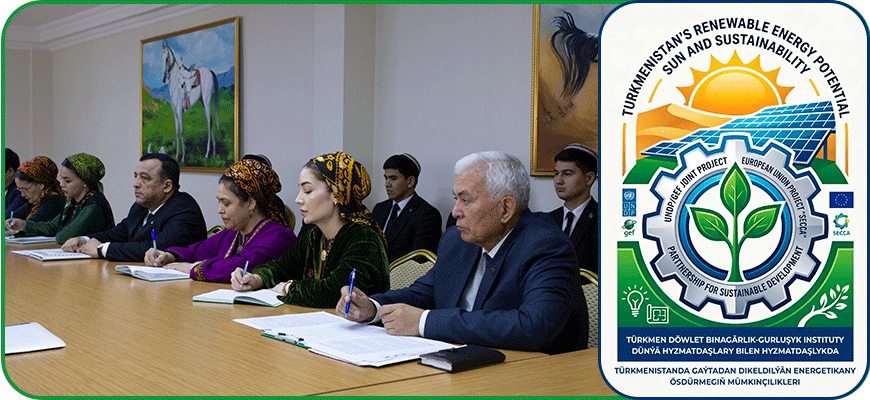
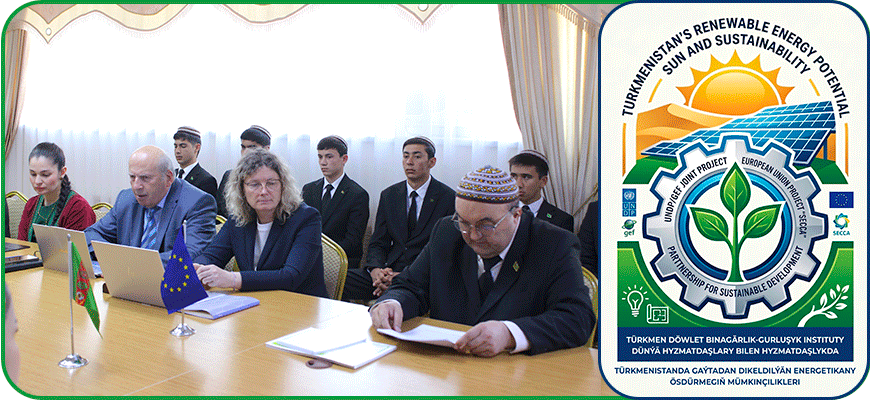
On April 28, 2026, a technical seminar titled "Opportunities for Developing Renewable Energy in Turkmenistan. Solar Energy Potential: Opportunities and Challenges" was held at the Turkmen State Architecture and Construction Institute. This event is one of the consistent steps toward strengthening the country's energy independence and transitioning to environmentally friendly energy sources.
The seminar was jointly organized by the Turkmen State Architecture and Construction Institute and two major international projects: the United Nations Development Programme and Global Environment Facility (UNDP/GEF) project "Enhancing National Capacities of Turkmenistan through the Improvement of the Regulatory and Legal Framework for the Energy-Efficient and Sustainable Construction Sector" and the European Union project "Sustainable Energy Connectivity in Central Asia" (SECCA). This international collaboration is aimed at adapting the world’s most advanced technologies to the national economy of Turkmenistan and enhancing the expertise of specialists in this field.
The primary focus of the seminar was directed toward the immense possibilities of utilizing solar energy within the natural and climatic conditions of Turkmenistan. The high number of sunny days per year in the country creates favorable conditions for the widespread implementation of photovoltaic (PV) systems and solar thermal collectors. International and national experts conducted an in-depth analysis of integrating solar energy not only into large-scale energy facilities but also into autonomous power supply systems for buildings.
However, the seminar also dedicated significant attention to the difficulties and "challenges" in this area. Technical issues such as the intermittent nature of solar energy, the necessity for energy storage systems, grid integration challenges, and mitigating the impact of sandstorms on panel efficiency were discussed. Experts emphasized the importance of innovative engineering solutions and digital management systems in creating sustainable energy connections.
Improving the regulatory and legal framework remains another vital pillar for the development of this sector. The work carried out within the project facilitates the practical implementation of Turkmenistan’s legislation on renewable energy sources and ensures that solar technologies are considered a mandatory element in construction standards. This, in turn, fully aligns with the country's sustainable urban development strategy.
Under the leadership of the Honorable President Serdar Berdimuhamedov, Turkmenistan ensures low-carbon development by transitioning toward “green” energy. Expanding the scope of renewable energy allows for the conservation of natural resources and a reduction in the environmental footprint. Seminar participants noted that this collaboration at both the international and national levels will play a key role in modernizing the country’s energy sector and preserving an ecologically clean world for future generations. The technical seminar concluded its work with productive consultations.
Science Department
of the Turkmen State Architecture and Construction Institute
